
Safe Passing & Smart Spacing
Metro Detroit’s highway system is one of the most freight-intensive in the Midwest. I-96, I-75, I-94, and the Lodge carry commercial trucks through Wayne, Oakland, and Macomb counties in high volume at all hours. Our I-96 towing team responds to road incidents on these corridors regularly, and the patterns in those calls give us a clear view of where passenger vehicle drivers run into trouble around semi trucks. Because the challenges here are not limited to open highway driving.
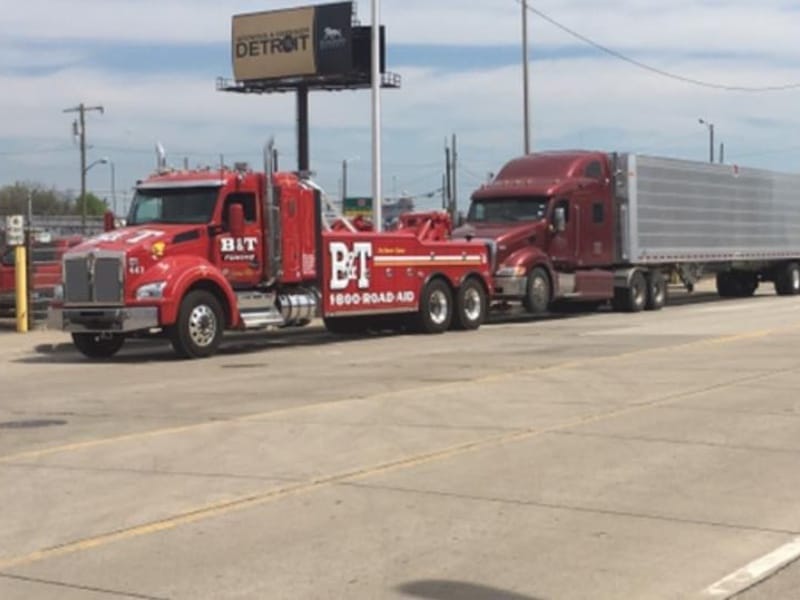
Detroit Roads Make Semi Truck Safety a Bigger Deal
Detroit’s interchanges, construction zones, and merge-heavy sections create conditions where the size difference between a passenger vehicle and a loaded semi becomes harder to manage. Drivers who understand a semi’s physical limitations carry a real safety advantage every time they are on these roads.
What Blind Spots Mean in Metro Traffic
A semi truck’s no-zones are the same in city and highway conditions, but the consequences in dense metro traffic can be harder to recover from. The dead zone directly alongside the trailer, the area just in front of the cab, and the 30-foot stretch directly behind the trailer are positions where the truck driver cannot see a smaller vehicle at all. In slow-moving or stop-and-go conditions, drivers sometimes linger in these zones far longer than they would at highway speed. When an I-96 towing call involves a semi, no-zone positioning is a consistent factor.
Stopping Distance and Speed: The Numbers That Matter
A loaded semi at 65 mph needs at least 40 percent more distance to stop than the average car at the same speed. At highway speed, that difference is measured in hundreds of feet, and even at lower metro highway speeds, the gap remains significant. A truck driver whose path is cut off has very few options. That reality is behind a large share of the calls our I-96 towing operators work on these corridors.
Speed differentials between lanes also create risk near semis. When a passenger vehicle cuts across a semi’s path during a merge or lane change, the truck driver’s ability to respond is limited by the weight and momentum of their load, not their skill or attention. Giving a semi full, visible clearance before any maneuver removes that risk.
Safe Habits Every Driver Should Practice Around Semis
The key behaviors are consistent and repeatable on any road with heavy truck traffic:
- Stay out of no-zones: do not ride alongside a trailer or sit directly behind it
- Signal well in advance of any lane change near a truck
- Allow a minimum of four seconds of clearance before merging ahead of a semi
- Reduce speed through construction zones where lanes narrow near large trucks
- Expect a semi to need extra room on curved interchanges and tight exits
- On any I-96 towing corridor and metro highway, assume heavy trucks are always nearby
Our I-96 towing dispatchers send units out to these roads daily. The patterns in those calls are predictable, and the habits above interrupt most of them.
When Weather or Construction Changes the Rules
Adverse conditions amplify every risk already present around a large truck. Wet pavement extends stopping distances for both vehicles. Reduced visibility from fog or rain makes it harder for a truck driver to spot a vehicle moving into their path. Construction zones narrow lane margins and force trucks to hold their lines tightly, leaving little room to adjust around sudden movements. On any I-96 towing corridor in Metro Detroit, the safest habit in poor conditions is to increase every buffer and reduce every speed.
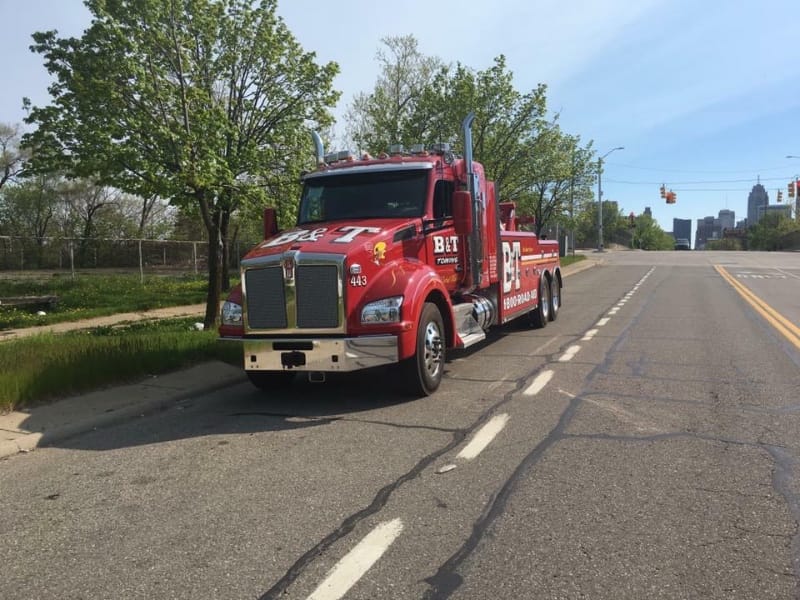
Boulevard & Trumbull Towing: Metro Detroit’s Trusted I-96 Towing Team
Boulevard & Trumbull Towing has served Metro Detroit since 1979, and I-96 towing has been part of our work for that entire run. As a woman-owned operation covering Wayne, Oakland, and Macomb counties, we hold our team to strict standards: National TIM Training certification, background checks, drug testing, and a dedication to ethical, transparent service on every call. Every operator understands both the roads and the protocols required to work them.
Our fleet handles everything from light-duty roadside assists to heavy-duty commercial recovery, and our I-96 towing coverage includes 24/7 response with dispatch that matches the right crew to every job. No hidden fees, no unnecessary delays, and a team that has spent over four decades earning the trust of the communities we serve.
FAQ
How do I handle merging near a semi truck on a busy highway ramp?
Match the speed of highway traffic before you enter the lane and assess where the semi is relative to your merge point. If the truck is occupying the lane you need to enter, slow down and merge behind it rather than forcing the issue alongside the trailer. Semis do not yield easily and cannot accelerate quickly to give you room.
What should I do if I am caught in a semi truck’s blind spot in heavy traffic?
Move through the blind spot as quickly as traffic conditions allow, either by speeding up to clear the front of the cab or slowing to drop behind the trailer. If traffic prevents movement, keep your vehicle as visible as possible and avoid making any sudden lane changes. The goal is to spend the least amount of time in the no-zone as conditions permit.
How does rain or fog change the safety rules around semi trucks?
In low visibility or wet conditions, all margins around semi trucks should increase. Following distance should extend, passing should be delayed until visibility allows for a full, clear view of the truck’s length, and merging maneuvers should be made with more conservative clearances. Stopping distances for both vehicles increase significantly on wet roads.
Are semi trucks more dangerous to drive near in construction zones?
Yes. Construction zones reduce lane widths, reduce visibility, and often involve uneven surfaces or lane shifts that affect truck handling. Semis have less lateral room to maneuver in a narrowed lane, and the consequences of any contact are greater when there are concrete barriers nearby. Reducing speed and increasing following distance through any active construction zone is the safest approach.
What causes most accidents involving semi trucks and passenger vehicles?
The most common causes involve passenger vehicle drivers underestimating stopping distances, misjudging blind spot positions, or cutting off a semi with insufficient clearance during a merge. Weather, fatigue, and distraction contribute across all vehicle types, but the size and weight differential means that errors in judgment around a semi tend to produce more serious consequences than equivalent errors between two passenger vehicles.
How much space should I leave when driving behind a semi truck at highway speed?
Four seconds of following distance is a practical minimum, which translates to roughly 350 to 400 feet at 65 mph. This gives you time to react to brake events while staying back far enough to see past the trailer if road conditions change ahead. In rain, reduce speed and increase that gap accordingly.